
The short answer: Komodo works well with children from around six or seven upwards, and a private charter works far better than an open trip. The limiting factors are not the dragons — they are the early starts, the sun, the tender transfers and the fact that a boat cannot turn around. Plan for shorter days and calmer months, and it is a genuinely good family trip.
What Actually Makes It Hard
Parents worry about the dragons. In practice the dragon trek is one of the easier parts — short, ranger-led, and closely supervised. The real challenges are more ordinary.
The 4am starts. The Padar sunrise means waking a child in the dark, putting them in a tender, and climbing a hill by headlamp. Some children love it. Some do not, and you will know which yours is.
The sun. There is no shade on the trails and limited shade on deck. Heat exhaustion is the most likely thing to go wrong on a family trip here.
Tender transfers. Every landing involves stepping between two moving boats. With a small child this needs a crew member, every time, without exception.
You cannot leave. On land, a bad afternoon means going back to the hotel. On a boat, the day continues. This is the single biggest difference from a land-based holiday.
Boredom between stops. Sailing legs are long. A child who needs constant stimulation will find the transit sections difficult.
Age by Age
| Age | Verdict | Notes |
|---|---|---|
| Under 4 | Difficult | No swimming independence, limited shade, hard transfers |
| 4–6 | Possible with a private boat | Skip the pre-dawn climbs; short days only |
| 7–12 | Excellent | The sweet spot — old enough to snorkel and hike, young enough to be amazed |
| 13+ | Excellent | Can do everything on the standard itinerary |
Why Private Beats Open Trip
This is the clearest recommendation on this page.
On an open trip, the schedule belongs to the group. If your child is tired, seasick or has had enough of a stop, there is nothing to be done. You are also sharing small spaces with strangers who did not book a holiday with children on it.
On a private charter, the schedule is yours. Skip the sunrise. Stay longer at the beach. Have lunch an hour early because someone is melting down. Ask the crew to anchor somewhere calm for the night. None of that is negotiable on a shared boat.
The cost difference is real but narrower than expected once a family occupies several cabins anyway.
Choosing Dates and Route
Go in the calmest months. May, June and October give the flattest seas and least motion. Avoid January to March — rough crossings with children are not worth the price saving. See our month-by-month guide.
Choose Rinca over Komodo Island for the dragon trek. Shorter sailing, shorter walk options, and elevated walkways near the ranger post that make supervising children much easier. Our Komodo versus Rinca comparison covers the difference.
Prioritise the sheltered snorkelling islands. Kanawa and Sabolan have shallow sand entries and calm water — far better for a first snorkel than a drift site. Our guide to snorkelling near Labuan Bajo covers which sites suit beginners.
Consider 4D3N rather than 3D2N. Counterintuitive, but a longer trip means a less compressed schedule, and compression is what causes family trips to unravel. See our itinerary comparison.
What Children Actually Enjoy Most
Worth knowing, because it is rarely what parents plan the trip around.
The bats at Kalong. Almost universally the surprise hit. It requires nothing of them — no walking, no swimming, no early start — and thousands of large animals filling the sky at dusk lands with children in a way a viewpoint does not. Covered in our Kalong Island guide.
Turtles while snorkelling. Consistently beats the coral, the fish and the scenery. A calm site where turtles are likely is worth more to a child than a spectacular drift site.
The boat itself. Sleeping on a wooden ship, eating on deck, watching the crew work. Many children rate the vessel above any single stop.
The dragons — genuinely, but often more in the retelling than the moment. The trek is hot and the animals are frequently still.
What lands least well: long sailing legs, and viewpoints that require a climb in the heat.
Seasickness and Children
Children are not automatically more prone to motion sickness than adults, but they are worse at anticipating it and less able to describe it early.
What helps: fresh air on deck rather than a cabin, eyes on the horizon rather than a screen during crossings, eating something light rather than nothing, and a larger vessel with more displacement, which moves less than a small boat in the same water.
Discuss any medication with your doctor before travelling rather than relying on what is aboard — dosing for children is not something to improvise at sea.
Choosing calm months does more than any remedy. May, June and October are the flattest.
Food and the Daily Rhythm
Meals aboard are generally Indonesian with Western options, cooked fresh in a small galley. Most crews handle simple requests well if told in advance — plain rice, plain noodles, fruit, no chilli. Tell the operator at booking, not on the first morning.
Bring a few familiar snacks. Not because the food is inadequate, but because a tired child who will not eat anything unfamiliar is a solvable problem if you packed for it.
On rhythm: the natural shape of a good family day is one big activity in the morning while it is cool, a long lazy afternoon swim, and an early evening. Trying to fit three landings into a day with children is where trips go wrong. A private boat lets you cut one.
What to Ask Before Booking
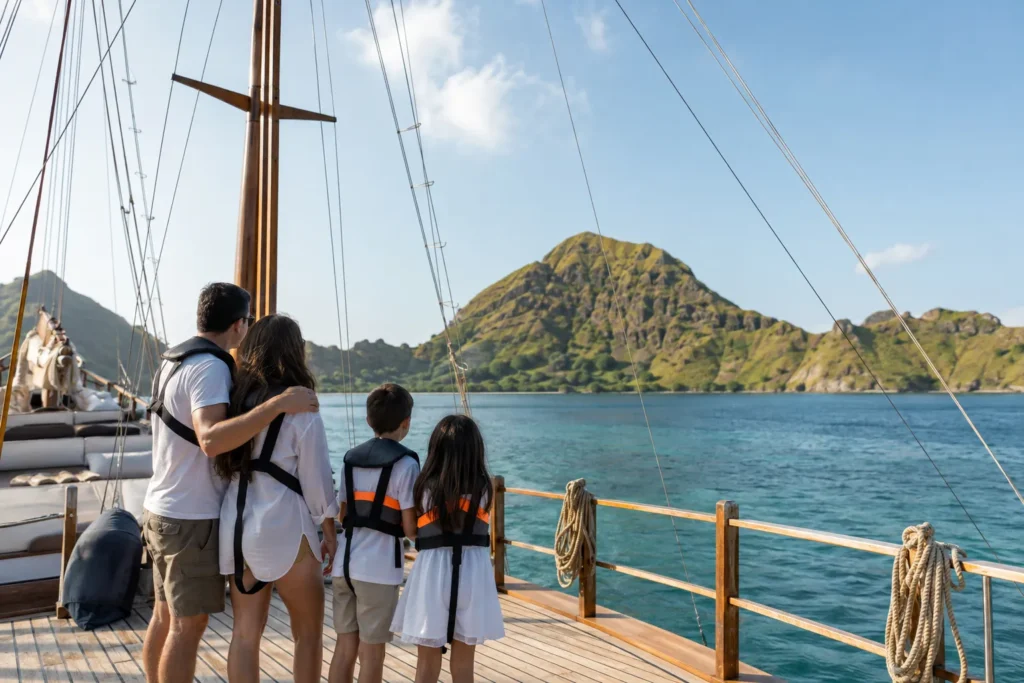
- Are there child-size life jackets aboard? Adult jackets do not work on a small child
- Is there shaded deck space? Not just a cabin — shaded outdoor space
- What is the crew-to-guest ratio for tender transfers?
- Can the itinerary be changed on the day?
- Is there a guide who will snorkel with the children?
- What is the cabin configuration? Adjoining or same-cabin options matter
- What is the plan if a child is unwell? Distance to Labuan Bajo from each anchorage
Packing for Children
- Long-sleeved rash guards — more reliable than reapplying sunscreen on a wet, wriggling child
- A properly fitting mask — boat spares rarely fit small faces, and a leaking mask ends snorkelling permanently
- Wide-brimmed hats with chin straps
- Reef-safe sunscreen, more than you think
- Motion sickness remedies suitable for their age, discussed with your doctor first
- Closed shoes with grip for the treks
- Headlamp each, if you are attempting a pre-dawn climb
- Downloaded entertainment — there is no signal in the park
- A small first aid kit with anything specific to your child
Safety on the Dragon Trek
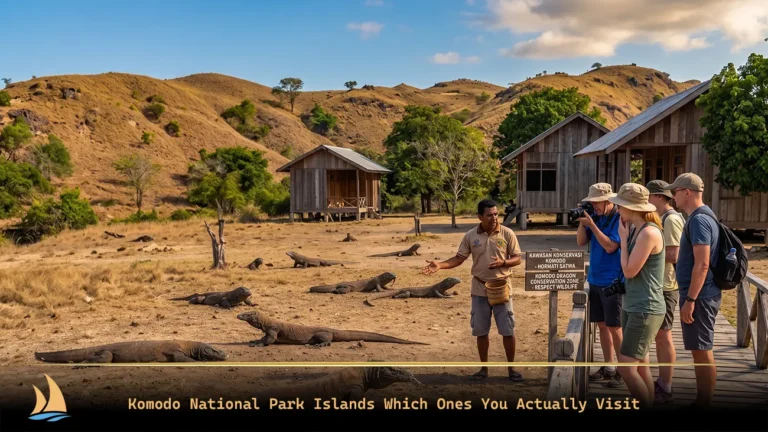
Rangers accompany every group and the protocol is strict, but with children a few points need reinforcing before you land:
- Children hold an adult’s hand throughout, and stay between the rangers
- No running, ever — movement attracts attention
- No crouching down for photographs
- Tell the ranger about any open cut or graze before starting
- Choose the short trek route rather than the long one
Our guide to Komodo dragons explains the animals’ behaviour, which is genuinely useful to read with an older child beforehand.
Frequently Asked Questions
Is Komodo National Park safe for children?
Yes, with supervision. Dragon treks are ranger-led and closely controlled. The greater risks are sun exposure, boat transfers and heat — all manageable with planning.
What is the minimum age for a Komodo boat trip?
Policies vary by operator and vessel. Around six or seven is where most families find the trip genuinely enjoyable rather than merely survivable. Confirm the specific boat’s policy when booking.
Can children do the Padar sunrise trek?
Physically, most children over seven manage the climb well. The obstacle is the pre-dawn start rather than the hill. On a private boat you can skip it without affecting anyone else.
Can children snorkel in Komodo?
Yes, at the sheltered islands with a float vest and an adult alongside. Start at a calm sand-entry site rather than a drift site.
Do children pay full price on a Komodo trip?
This varies by operator and by whether the child occupies a separate berth. Park entry fees are charged per person regardless of age. Ask for the all-in figure per child rather than a discount percentage.
What if my child cannot swim?
Float vests make the sheltered snorkelling sites accessible to non-swimmers with an adult alongside. Tell the crew before the first water stop rather than at the ladder.
Is a liveaboard or a hotel better with kids?
A private liveaboard for the park itself, ideally shorter rather than longer at sea, with hotel nights either side. Hotel-based day trips work too but involve more early starts and more transfers.
Planning a Family Trip
Start with dates in our month-by-month guide, then trip length in the itinerary comparison, and the town in our Labuan Bajo travel guide. Browse Komodo tour packages or talk to our team about private charters suited to families.