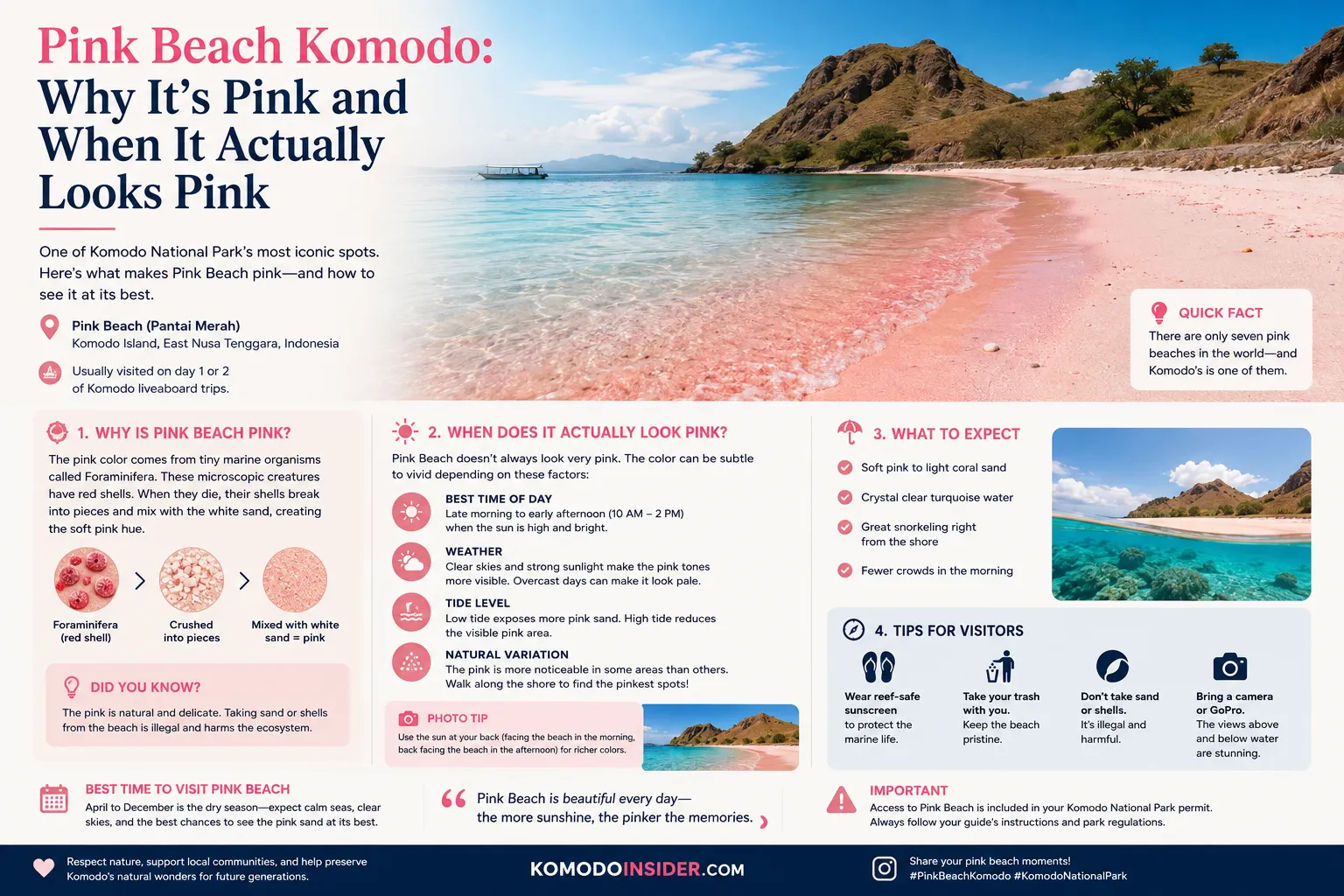

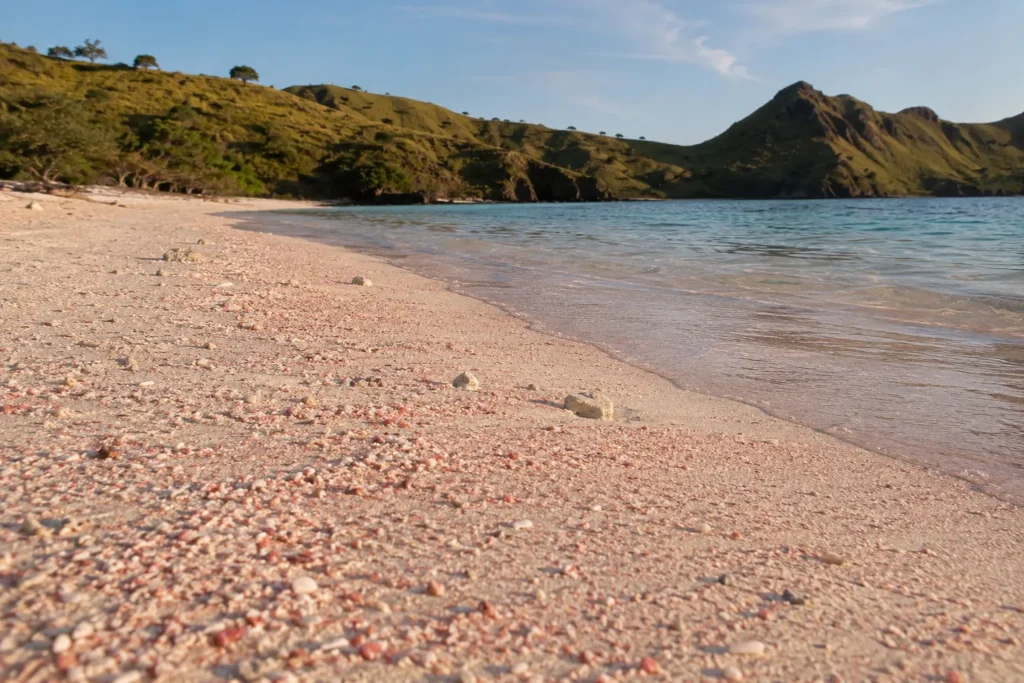
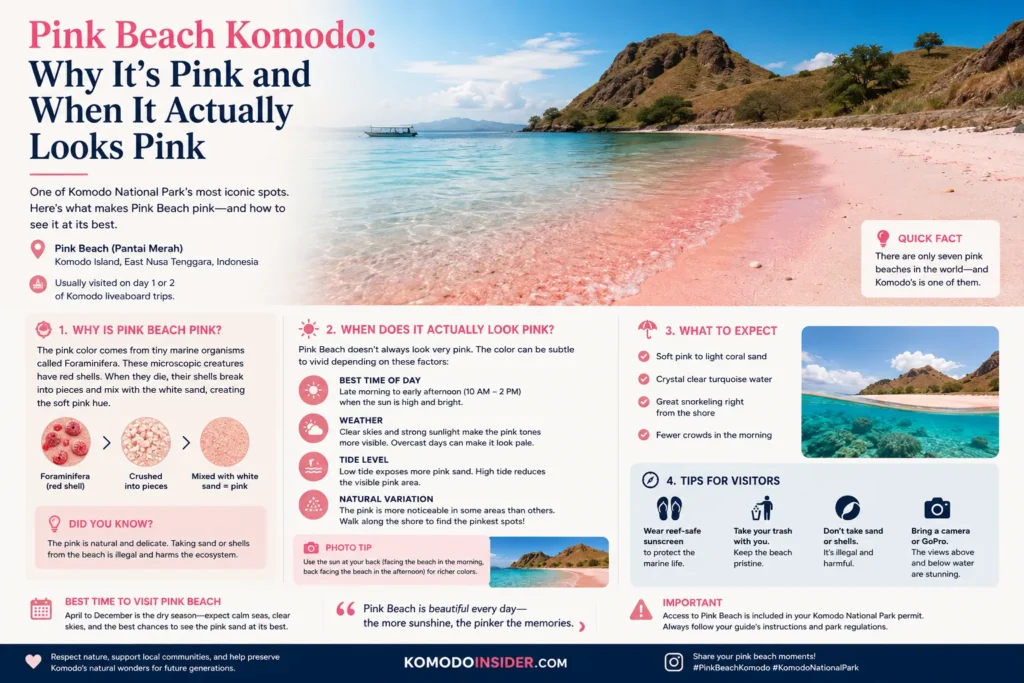
The short answer: Pink Beach in Komodo, known locally as Pantai Merah, gets its colour from fragments of red organ-pipe coral mixed into white sand. The pink is real but subtle — strongest at the waterline where the sand is wet, and in low-angle light early or late in the day. At midday under a high sun it mostly reads as pale cream, which is why so many visitors come away puzzled.
Why the Sand Is Pink
The colour comes from a marine animal, not a mineral.
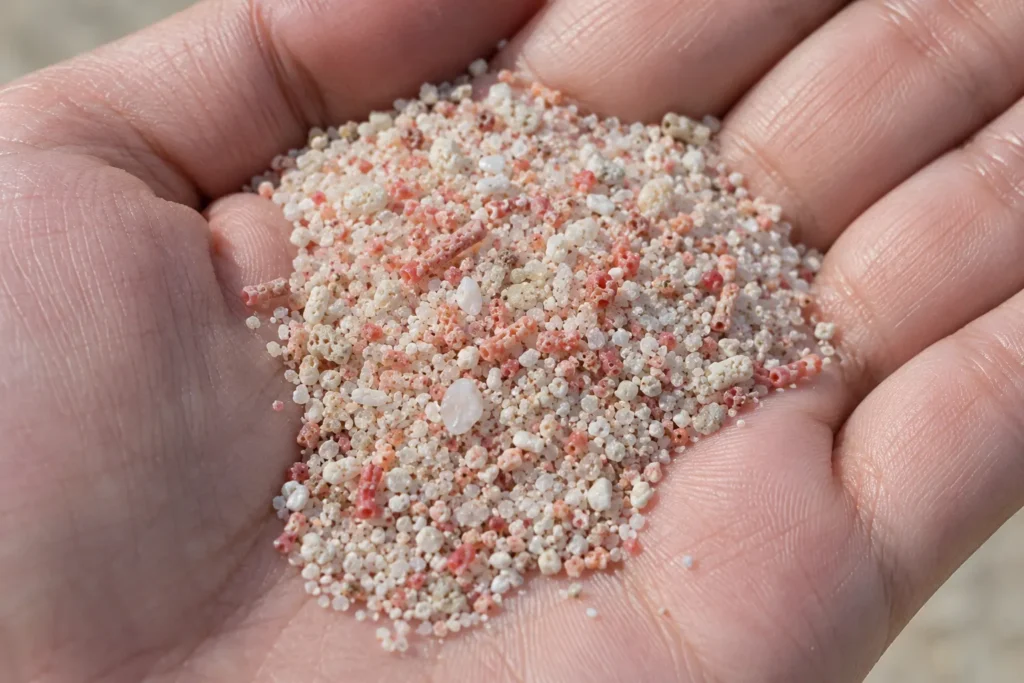
Organ-pipe coral is a soft coral with a hard red skeleton made of calcium carbonate. When colonies die and break down, waves and reef fish grind the skeleton into fragments that wash ashore alongside ordinary white sand made of quartz and shell. The red particles are a minority component — they tint the sand rather than dominating it.
This is why the effect is a blush rather than a bold colour, and why it varies along the beach: wave action concentrates the fragments in some stretches and disperses them in others.
The same mechanism produces a handful of pink beaches worldwide, in the Bahamas, Bermuda and Sardinia among others. Komodo’s is one of the more accessible and sits alongside genuinely good snorkelling, which most of the others do not.
When It Actually Looks Pink
Three variables, in order of how much they matter.
Wet sand beats dry sand. Water saturates the grains and deepens the colour considerably. The strip along the waterline is always noticeably pinker than the dry sand above it. If you want the colour, stand at the edge of the water.
Low sun beats high sun. Early morning and late afternoon light rakes across the beach and picks up the red. Overhead midday light flattens it. Most day-trip itineraries arrive around the worst possible time.
Tide. A receding tide exposes a wider band of freshly wetted sand, which is the best of both.
Season affects it far less than people expect. There is no month when the beach is dramatically pinker.
Managing your expectations
Worth saying directly: many of the images circulating online are heavily saturated. The real beach is prettier than a plain white beach and considerably less vivid than a bubblegum-pink stock photo.
Visitors who arrive expecting the edited version are often disappointed; visitors who arrive expecting a soft rose blush against turquoise water are usually delighted. It is the same beach — only the expectation differs.
Snorkelling at Pink Beach
The snorkelling here is underrated and, for many guests, the better half of the stop.
The reef starts close to shore and drops away gently, so you can swim out from the beach without a tender. Expect hard and soft corals, reef fish in quantity, and frequently turtles. Visibility is generally good and the site is sheltered compared with the channel sites, making it a comfortable option for less confident swimmers.
Practical notes: entry is over sand rather than rock, current is usually mild but check with your crew, and there is no shade on the beach — a rash guard beats reapplying sunscreen.
Getting There
Pink Beach sits on Komodo Island and appears on most itineraries of three days or more, typically paired with a dragon trek at Loh Liang since both are on the same island. Boats anchor off and tender guests ashore.
Time ashore is usually 45 to 90 minutes depending on the itinerary. If your priority is the colour rather than the swim, ask your crew whether an early or late slot is possible — on a private charter it often is.
Our itinerary comparison covers which trip lengths include Pink Beach and how much time each allows.
Photography Tips
- Shoot low. Get the camera close to the sand and shoot along the beach rather than down at it — a shallow angle stacks the pink grains visually
- Include the waterline. The contrast between wet pink sand and turquoise water is what makes the shot work
- Use a polariser to cut surface glare and deepen the water
- Avoid midday if you have any choice at all
- Drones require a permit applied for in advance — flying without one risks confiscation
Rules and Conservation
Do not take sand. It is tempting, it seems harmless at the scale of a handful, and it is prohibited.
The reasoning is straightforward: the red fragments are a finite deposit replenished slowly by a living reef, and thousands of visitors each taking a small amount removes the beach faster than it forms. Removing coral, shells or sand from the national park carries penalties.
Also: reef-safe sunscreen, stay within designated swimming areas, and take everything you brought back to the boat.
Frequently Asked Questions
Is Pink Beach Komodo really pink?
Yes, though subtly. The colour is a soft rose most visible on wet sand at the waterline and in low-angle morning or afternoon light. Heavily saturated photos online overstate it.
Can you swim at Pink Beach?
Yes. The water is calm and shallow near shore with easy sand entry, and the snorkelling just offshore is among the more relaxed sites in the park.
How long do you spend at Pink Beach?
Typically 45 to 90 minutes on a standard itinerary — enough for a swim, a snorkel and photographs.
Why is Pink Beach pink?
Fragments of red organ-pipe coral skeleton mix with white sand. The red particles tint the overall colour without dominating it.
Can you take sand from Pink Beach?
No. Removing sand, coral or shells from Komodo National Park is prohibited and subject to penalties.
Visiting Pink Beach
Pink Beach pairs naturally with a dragon trek — see our comparison of Komodo Island versus Rinca — and appears on most multi-day routes. Check permit requirements before fixing dates, then browse Komodo tour packages or check availability with our team.