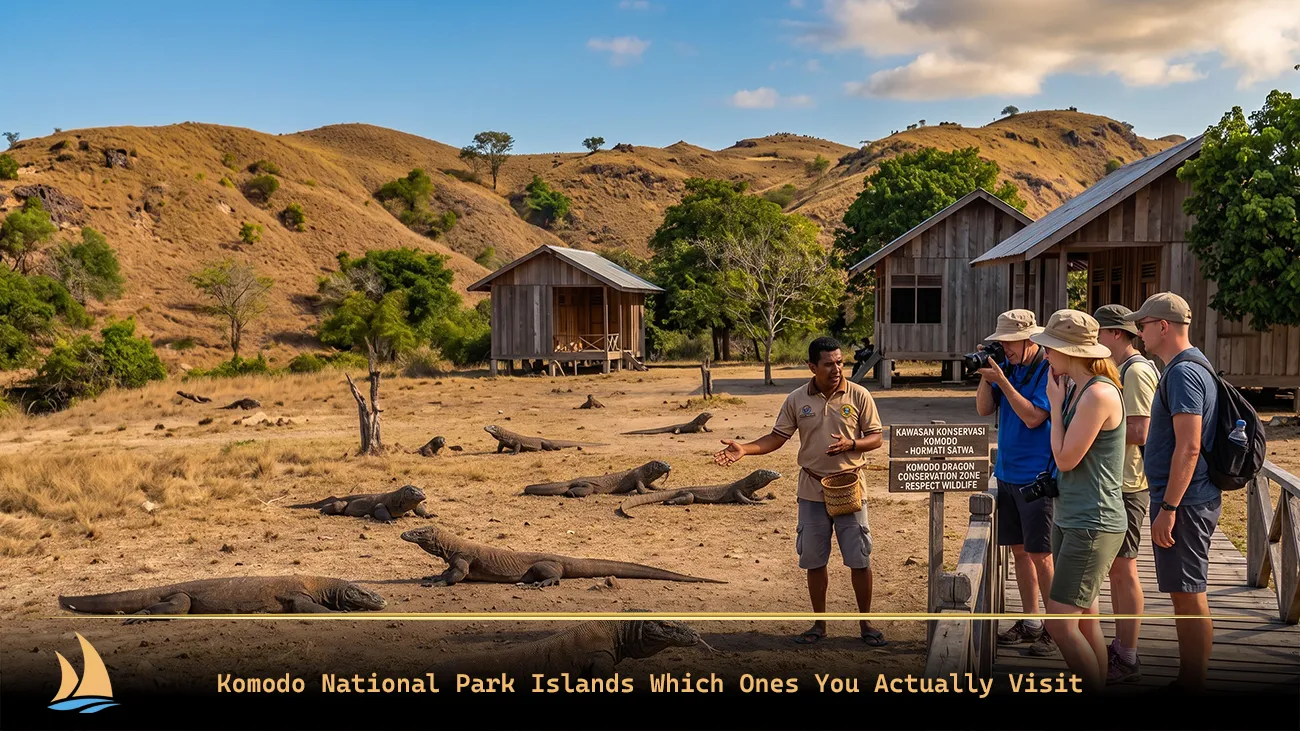

The short answer: choose Rinca if you want the highest chance of seeing dragons with the least sailing time. Choose Komodo Island if you want the island the animal is named after, and you are combining the trek with Pink Beach. Both give you a real dragon encounter with a ranger; neither is a compromise. Since April 2026 the choice also affects your permit route, so it needs deciding before you book rather than on the day.
Side by Side
| Rinca (Loh Buaya) | Komodo Island (Loh Liang) | |
|---|---|---|
| Sailing time from Labuan Bajo | Shorter | Longer |
| Dragon sighting density | Generally higher | Good, more spread out |
| Terrain | Rolling, more open savannah | Flatter near the post, more wooded |
| Trek options | Short, medium, long | Short, medium, long |
| Crowds | Usually lighter | Busier midday |
| Nearby highlight | Closer to Padar | Adjacent to Pink Beach |
| Permit route | Rinca route | Komodo route |
Rinca Island (Loh Buaya)
Rinca is the closer of the two and, for most travellers, the better trek.
The landing area and visitor facilities were rebuilt in recent years, with elevated walkways near the ranger post. Dragons frequently gather in the shade around the buildings — which sounds artificial until you realise they have always done this, and the walkway simply gives you a safe vantage point.
Beyond the post the trail climbs into open savannah with wide views back over the bay. Three trek lengths are usually offered; the medium route is the sweet spot for most people, taking around an hour.
Rinca also holds water buffalo, wild boar, macaques and megapode nesting mounds — a fuller wildlife picture than dragons alone.
Komodo Island (Loh Liang)
Komodo Island is larger, further out, and carries the name. The trek from Loh Liang starts through drier woodland before opening into savannah.
Dragons here range across a bigger area, so encounters are less concentrated around the ranger post and more genuinely in the wild. Some travellers prefer this; others find Rinca’s reliability more satisfying.
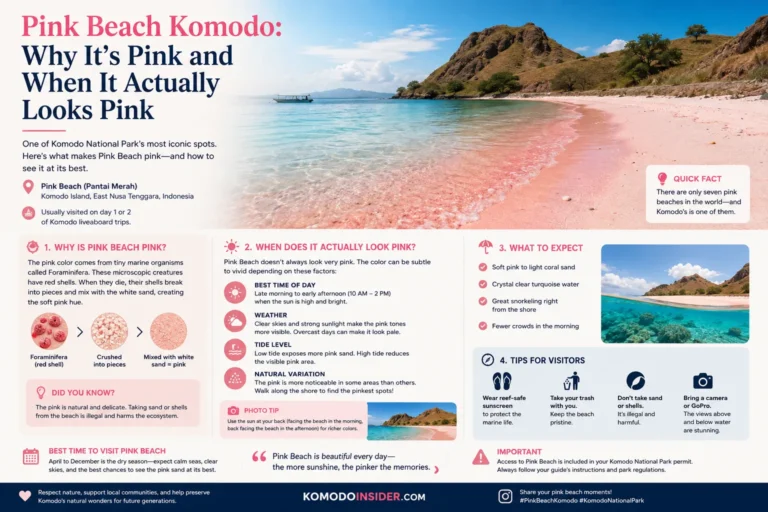
Its practical advantage is position. Pink Beach sits on the same island, so a Komodo Island trek pairs naturally with a snorkelling stop — which is why many 3D2N routes choose it.
Sighting Likelihood, Honestly
Nobody can promise you a dragon. What can be said reliably:
Time of day matters more than island. Dragons are ectothermic and most active in the cooler hours. Early morning treks consistently outperform midday ones, at both sites.
Season matters. The dry months from April to October are the most reliable overall. Mating season, roughly June to August, is the exception — males range more widely and become harder to find, though you may witness territorial behaviour instead.
Rangers know where they are. Rangers track territories daily and will route your trek accordingly. This is the single biggest factor in whether you see one, and it is entirely outside your control.
Safety and Ranger Protocol
A licensed ranger is mandatory on both islands. This is not a formality — Komodo dragons are ambush predators with a serious bite, and the protocol exists because incidents have happened.
What to expect and follow:
- Groups stay together, with rangers front and back. Do not lag behind for photographs
- Maintain the distance your ranger specifies and never approach a dragon from behind
- The forked stick rangers carry is a real deterrent tool, aimed at the animal’s sensitive neck area, not a prop
- No crouching, squatting or sudden movement — a crouching human reads differently to a dragon than a standing one
- Never feed, touch, or attempt to attract a dragon
- Stay on marked paths at all times
On the menstruation question. You will find claims online that menstruating visitors are banned. In practice, park guidance is that visitors who are menstruating should inform their ranger so they can be accompanied more closely — it is a precaution based on the animals’ acute sense of smell, not an exclusion. Check current guidance with your operator, and disregard the folklore versions.
Cost and Permit Differences
The two routes are separate permit entries at different prices, and each site carries its own daily sub-limit within the park-wide cap. This has a practical consequence: if your preferred route is full on your dates, the other may not be.
Because fee figures are currently reported inconsistently across sources, we cover the position in detail — including what is officially confirmed and what is not — in our guide to Komodo National Park permit booking.
Frequently Asked Questions
Which island is better for seeing Komodo dragons?
Rinca generally offers higher sighting density and a shorter sail. Komodo Island offers a more dispersed, wilder encounter and pairs with Pink Beach. Both are reliable with a ranger.
Can you visit both islands on one trip?
Yes, most 4D3N itineraries include both, and some 3D2N routes manage it. Check whether your permit route covers both before assuming.
Are Komodo dragons dangerous to tourists?
They are genuinely dangerous animals, which is why ranger accompaniment is compulsory. Incidents almost always involve people who left the group or the trail. Following the protocol reduces the risk to very low.
Can you see Komodo dragons year-round?
Yes. They are present all year. Sightings are most reliable in the dry season and in early morning, and least predictable during mating season around June to August.
Which island is better for families?
Rinca, usually — shorter sailing, shorter trek options, and elevated walkways near the ranger post that make supervising children easier.
Planning the Trek
Which island you visit is usually determined by your route, so decide it alongside your itinerary — see our comparison of 2D1N, 3D2N and 4D3N trips and our month-by-month guide for the best dragon-spotting conditions. Browse Komodo tour packages, or ask our team which departures cover which island.