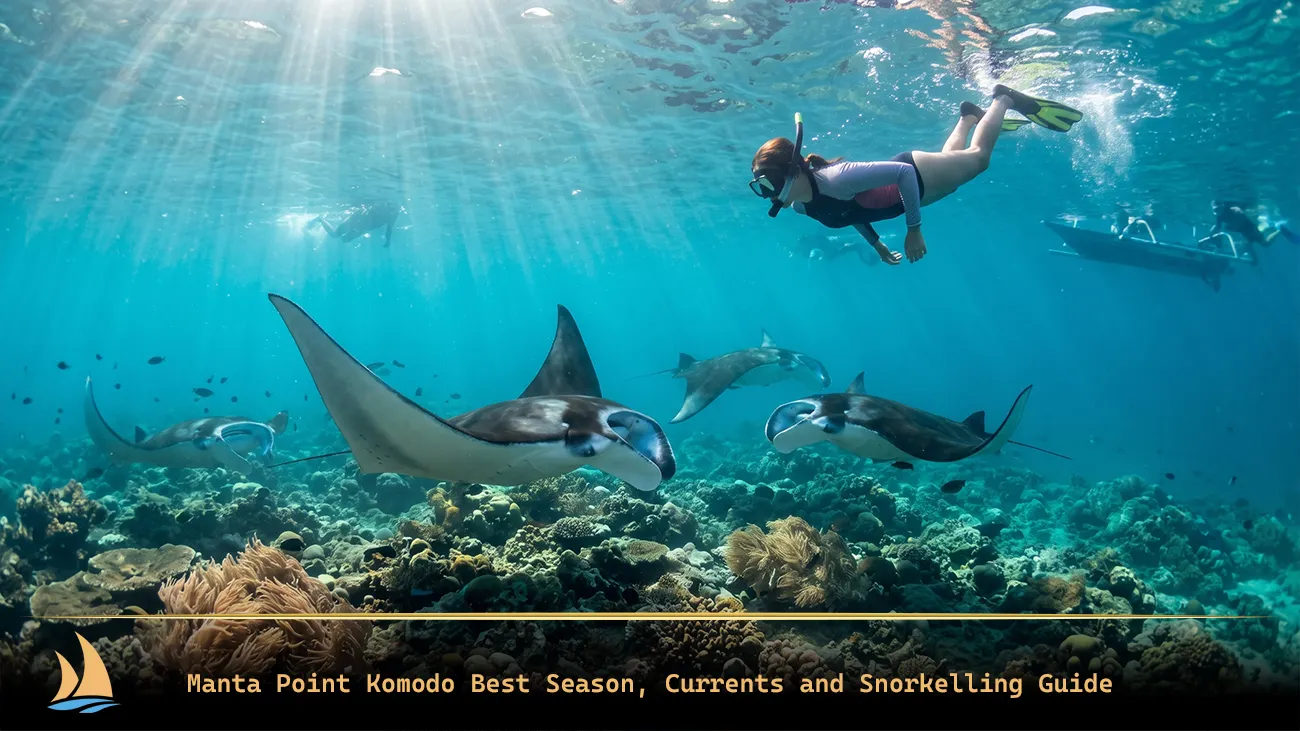

The short answer: Manta Point in Komodo is Karang Makassar, a shallow drift site between Komodo and Rinca. Mantas are seen year-round, with the strongest aggregations from December to March when plankton blooms bring them in to feed. It is one of the few world-class manta sites that works genuinely well for snorkellers, not just divers — provided you understand the current.
Where Manta Point Actually Is
The site most boats call Manta Point is properly named Karang Makassar — a long, shallow rubble and coral bank in the channel between Komodo and Rinca islands. Dive-literate travellers and most crews use the local name, so it is worth knowing both. If a briefing mentions Karang Makassar, that is where you are going.
It is a cleaning and feeding station rather than a reef you swim over for the coral. The bottom is unremarkable — broken rubble, patchy hard coral, sand. The reason to be there is what passes above it.
The channel funnels water between two large islands, and that constriction is the whole story. Tidal flow accelerates through the gap, carrying plankton with it, and the bank sits shallow enough that the food concentrates within a few metres of the surface. Mantas come to feed on it, and to be cleaned by wrasse and butterflyfish working the bank.
Most Komodo itineraries of three days or more include it, usually on the main sightseeing day. Sailing time from the standard anchorages is short.
Best Time to See Manta Rays
Manta activity tracks food, and food tracks the season.
| Period | Likelihood | Water clarity | Current |
|---|---|---|---|
| December – March | Highest — peak aggregations | Reduced by plankton | Variable |
| April – June | Good | Improving to very good | Moderate |
| July – September | Moderate to good | Best of the year | Strongest |
| October – November | Building | Good | Moderate |
The mechanism matters because it explains a trade-off nobody markets honestly. Plankton blooms in the wet months are what draw large numbers of mantas — but plankton suspended in the water is also what reduces visibility. Peak manta season and peak clarity are not the same season. A December encounter may involve more animals in murkier water; a August encounter may involve fewer animals in glass.
April is the practical sweet spot: enough residual plankton activity to keep mantas around, calm seas, and clearing water. See our month-by-month sailing guide for how this fits with everything else you might want to time your trip around.
Time of day and tide
Season sets the odds; tide sets the hour. Feeding activity concentrates around moving water, so the productive windows follow the tidal cycle rather than the clock. A crew working from the tide table will aim for the site at a specific time, which is why two boats can visit the same day with very different results.
Slack water — the pause between tides — is generally the most comfortable for snorkellers but not always the most active for mantas. A moderate flow is the compromise most guides aim for.
Snorkelling at Manta Point
This is where Karang Makassar differs from most famous manta sites: you do not need to dive. The animals feed and get cleaned in shallow water, and on a good day you will see them clearly from the surface — sometimes within a few metres.
How the drop works
The tender positions up-current of the bank and the group enters the water together, not one at a time. This matters more than it sounds: a strung-out group drifts apart at different rates and becomes difficult for the boat to track.
Listen to the briefing about which direction the current is running. It reverses with the tide, and the answer today is not the answer yesterday.
The drift
You do not swim to the mantas. You let the current carry you along the bank while the tender shadows the group. Fighting the current exhausts you within minutes and achieves nothing — the site is a conveyor belt and the correct technique is to ride it.
Keep your head down and scan ahead and below rather than around you. Mantas appear out of the blue-green haze at the edge of visibility and are often past you before you notice if you are looking sideways.
When one appears
Stay at the surface. Stay still. Breathe.
This is counter-intuitive and it is the single most useful thing on this page. Mantas approach curious, motionless snorkellers and leave when chased. The most reliable way to get a close encounter is to stop swimming entirely and let the animal decide. Groups that hold position routinely get passes within touching distance — which they should not take.
Fin discipline
Keep fins below you and horizontal. Kicking downward stirs sediment off the bank and destroys visibility for everyone behind you, including the people who were about to have the encounter of their trip.
Never stand on the bank. It looks like rubble; parts of it are living.
The pickup
The tender collects you downstream. Do not attempt to swim back to the entry point — that is a long fight against moving water and the boat is coming to you anyway. Raise an arm if you need assistance.
When it is not suitable
On strong-current days, or when swell makes surface conditions choppy, this site is not appropriate for weak swimmers or nervous snorkellers. A responsible crew will say so and offer an alternative.
If nobody assesses conditions before putting you in the water, that tells you something about the operator. Ask what the plan is if the current is running — a good answer exists.
What to wear: a rash guard rather than repeated sunscreen — you will be face-down at the surface for a long time and your back takes the full sun. Reef-safe sunscreen only. A float vest is available on most boats and there is no shame in using one; it makes holding position effortless, which is exactly what you want.
Diving Manta Point
As a dive, Karang Makassar is shallow and undemanding in profile but current-driven, which is where the skill requirement sits. Divers typically drift along the bank at modest depth, holding position near cleaning stations rather than swimming the site.
It suits open-water divers with some current experience. The common approach is to drift and then settle on sand or rubble away from living coral to watch a cleaning station work. Reef hooks are used at some Komodo sites; here the usual method is simply to find a patch of dead substrate and stay low.
On strong days the site moves quickly and a guide who knows the tide table matters more than anyone’s certification level. Buoyancy control matters more than experience count — a diver who cannot hold depth will silt the station and end the encounter for the group.
Divers who want the current-driven sites at their best should look at a 4D3N itinerary, which allows dives to be scheduled around slack water rather than squeezed between sightseeing stops.
What You Are Actually Looking At
The animals at Karang Makassar are reef manta rays, the smaller of the two manta species, typically spanning three to four metres across the wings. They are filter feeders with no sting, no teeth of consequence, and no interest in people.
Each manta carries a unique pattern of spots on its underside, which researchers use to identify individuals in the same way as a fingerprint. If you get a clear photograph of the belly, it has genuine scientific value — several regional ID databases accept public submissions.
Mantas are slow to reproduce, typically producing a single pup at long intervals, which is why populations recover badly from pressure and why protection matters. Manta rays are protected in Indonesian waters.
Manta Etiquette
These are not politeness rules. The site’s quality depends on the animals continuing to find it worth visiting.
- Never touch a manta. Their skin carries a protective mucous layer; contact damages it and opens the animal to infection
- Do not chase or block. Approaching head-on or swimming into their path causes them to abandon the station
- Stay above, not underneath. Positioning below a manta interrupts cleaning behaviour and pushes it off the site
- No flash photography
- Keep several metres of distance and let them close it if they choose
- No touching the bottom — cleaning stations are living reef
- Reef-safe sunscreen only
Groups that follow this reliably get better encounters than groups that do not. The mantas stay longer. This is not a moral claim; it is an observable pattern that every guide working the site will confirm.
Manta Point vs Manta Alley
Two different sites, frequently confused.
| Manta Point (Karang Makassar) | Manta Alley | |
|---|---|---|
| Location | Channel between Komodo and Rinca | Southern Komodo |
| Access | On most standard itineraries | Requires a longer trip and settled seas |
| Suits | Snorkellers and divers | Divers |
| Conditions | Shallow, drift | Cooler water, stronger conditions |
| Crowds | Can be busy midday | Quiet |
If a trip advertises Manta Alley on a short itinerary, check the routing — the southern sites are weather-dependent and are the first thing dropped when conditions turn.
Avoiding the Crowds
Karang Makassar is on every standard itinerary, which means midday can bring a queue of day boats and a lot of fins in the water. Two ways around it.
Go early or late. Boats that overnight inside the park can reach the site before the day-trip fleet arrives from Labuan Bajo, or after it has left. This is a genuine advantage of multi-day sailing over day trips and it applies to Padar in exactly the same way.
Ask before you book. On a private charter the timing is yours to set. On an open trip it is not — worth knowing which you are buying.
What Else You Will See
Green and hawksbill turtles are common along the bank, along with reef sharks, eagle rays, schooling fusiliers and the occasional larger pelagic passing through the channel. Taka Makassar, a crescent sandbar that emerges around low tide, sits nearby and is usually visited in the same stop.
The bottom itself is rubble and low coral rather than a showcase reef — come for the animals, not the scenery. If you want reef, the sheltered sites on the inner islands are better.
Frequently Asked Questions
Are manta rays dangerous?
No. Mantas have no stinger and no interest in people. The risks at the site are the current and boat traffic, not the animals.
Can beginners snorkel at Manta Point?
Confident swimmers, yes, with a guide and a proper briefing. It is a drift site, so it is not the place to snorkel for the first time. On strong-current days the crew may rule it out entirely, and they should.
Are manta sightings guaranteed?
No, and be wary of anyone who says otherwise. These are wild animals at a feeding station. Encounter rates are high in season and lower outside it, but there is no guarantee on any given day.
What is the best month for manta rays in Komodo?
December through March for the largest aggregations, April for the best combination of sightings and comfortable conditions.
Do you need to dive to see mantas in Komodo?
No. Karang Makassar is shallow enough that snorkellers regularly get excellent encounters from the surface.
How deep is Manta Point Komodo?
The bank is shallow — shallow enough that surface snorkellers see cleaning behaviour clearly. Divers work modest depths along it rather than descending significantly.
How long do you spend at Manta Point?
Usually 45 to 90 minutes, often split across more than one drift depending on conditions and how the encounters go.
Sailing to Karang Makassar
Manta Point features on most multi-day routes — see our itinerary comparison for which trip lengths include it, and check permit and quota requirements before fixing dates. If you are also planning a dragon trek, our comparison of Komodo Island versus Rinca covers the choice. Browse Komodo tour packages and Indonesia liveaboard itineraries, or talk to our team about boats carrying a dedicated snorkelling guide.