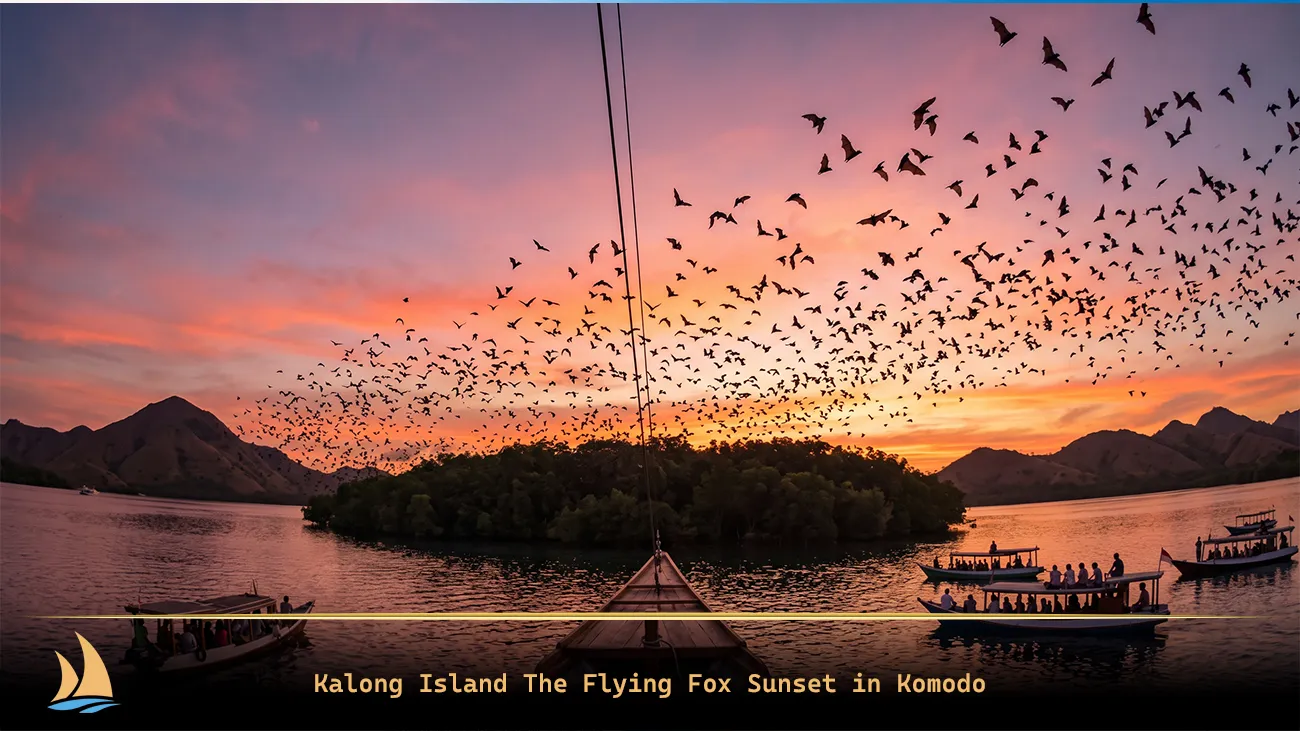

The short answer: Kalong Island is a mangrove island near Labuan Bajo where thousands of large fruit bats — flying foxes — leave the trees at dusk to feed on Flores. Boats anchor offshore and watch from the deck as the colony lifts off in a continuous stream against the sunset. It takes about twenty minutes, requires nothing of you but a seat, and is one of the more genuinely surprising hours in Komodo.
What Actually Happens
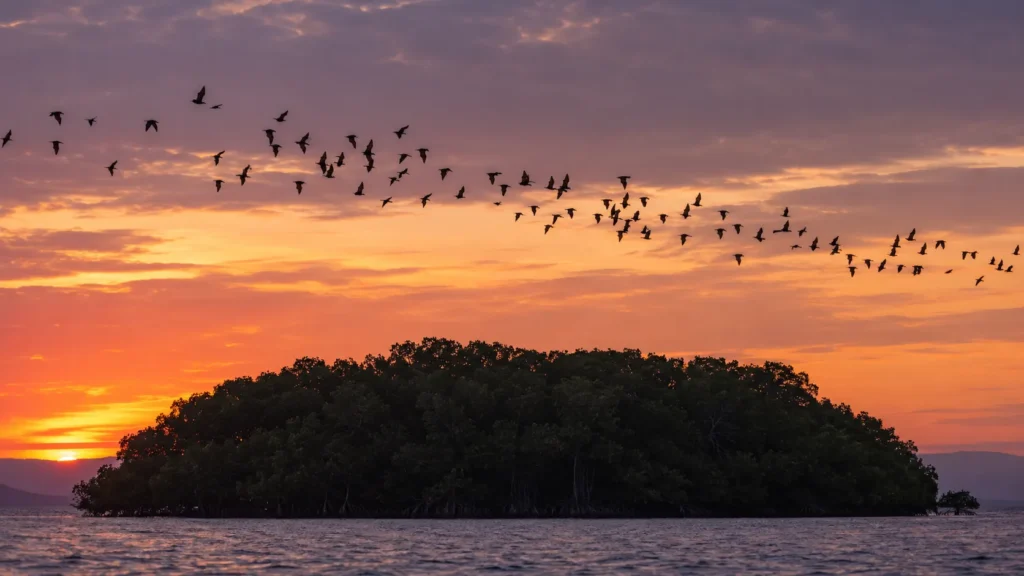
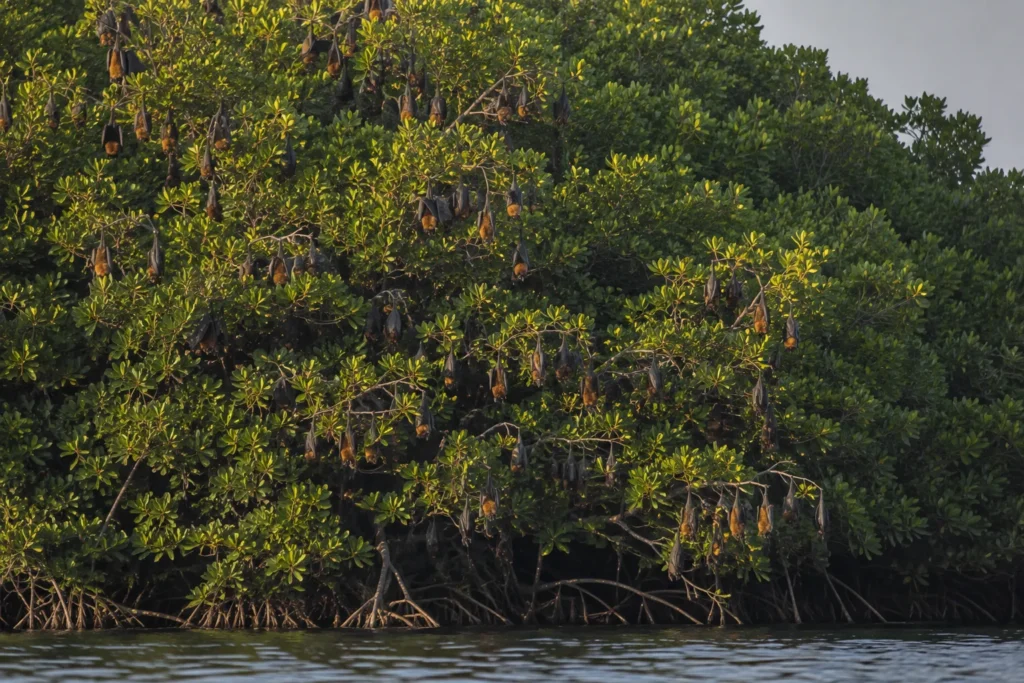
Kalong — the name simply means flying fox in Indonesian — is a low mangrove island with no beach and nothing to land on. The bats roost in the mangroves through the day, hanging in the canopy in numbers that are hard to register until they move.
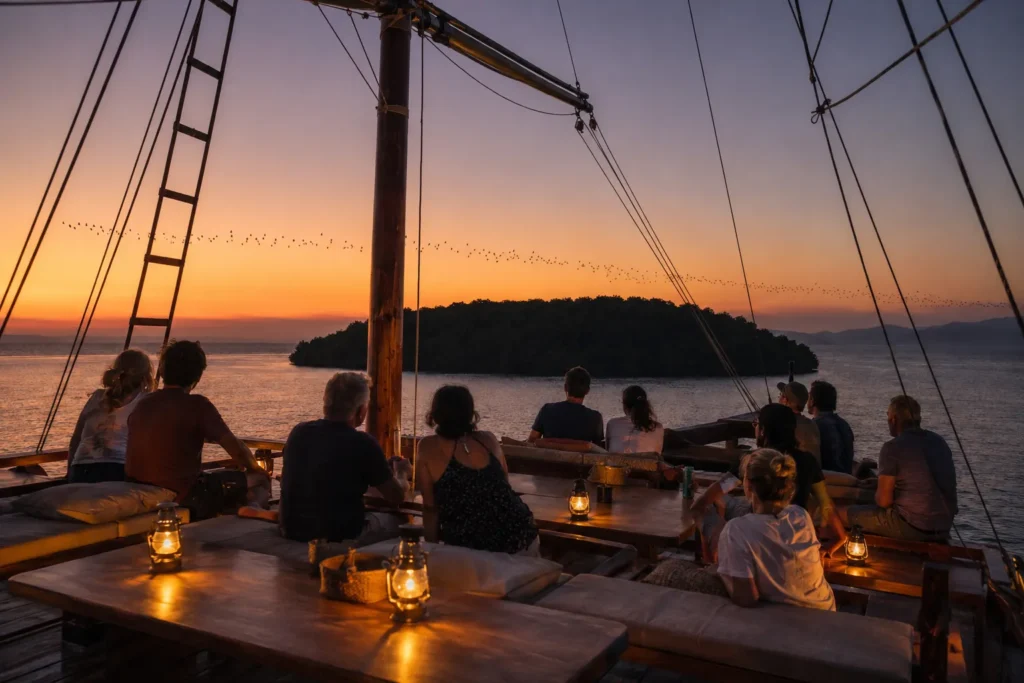
Around sunset, the colony wakes. The departure is not a single burst but a build: a few individuals first, then dozens, then a continuous stream that keeps going for fifteen to twenty minutes. They cross the water toward Flores to feed on fruit, and return before dawn.
These are large animals — fruit bats with wingspans over a metre, flying with slow deliberate wingbeats rather than the flicker of small insectivorous bats. From a boat a few hundred metres offshore, you see them clearly against the light.
What the Animals Actually Are
These are flying foxes — large fruit bats, not the small insect-eating bats most people picture. The difference is worth knowing, because it changes what you are watching.
Flying foxes have wingspans that can exceed a metre, fox-like faces with large eyes, and they navigate by sight and smell rather than echolocation. They eat fruit, nectar and blossom. The flight is slow and steady, closer to a heron than to the erratic flicker of a small bat, which is why the departure reads as a procession rather than a swarm.
They roost communally through the day, hanging in the mangrove canopy in dense clusters. If you pass Kalong in daylight you can see them: what looks like unusual dark fruit hanging in the trees, occasionally shifting and stretching a wing.
Why the Colony Matters
The spectacle is the reason boats stop. The ecological role is the reason the colony is worth protecting.
Flying foxes are among the most important seed dispersers and pollinators in tropical forests. Because they travel long distances between roost and feeding grounds — in this case crossing open water to Flores every night — they carry seeds and pollen far beyond where a smaller animal could. Several tree species depend heavily on them.
Colonies like this are also fragile. They concentrate an enormous number of animals into one small stand of mangrove, which means a single disturbance event affects the whole population at once. That concentration is exactly why boats watch from a distance and nobody lands.
Where It Sits in an Itinerary
Kalong is almost always the last stop on day one. The reason is geographic rather than editorial: the island sits on the route between the near islands and the sheltered anchorages where boats overnight, so the timing falls into place naturally.
This makes it effectively a multi-day-trip experience. Day boats returning to Labuan Bajo before dark generally cannot include it — sunset is when they need to already be heading home. Our day trip versus liveaboard comparison covers this kind of trade-off in more detail.
Getting the Most From It
- Be on deck early. The build is gradual and the best light is before the sun is fully down. Guests who come up when someone shouts have missed the opening
- Watch, then photograph. Twenty minutes is long enough to do both, and the experience is better in that order
- Bring insect repellent. You are anchored beside a mangrove at dusk
- A long lens helps but is not essential. The scale of the stream is the point, and a wide shot with the island and the sky captures that better than a tight crop of one animal
- Ask the crew which side to sit. The flight line depends on wind and where the boat has swung on its anchor
The Rest of That Evening
Kalong is rarely a standalone stop. It sits inside the best hour of the first day, and the sequence around it is part of why guests remember it.
The boat usually arrives with time in hand, so there is a stretch of golden light on deck before anything happens. Dinner is often being prepared. The bats build and pass. Then the boat lifts anchor in the dark and moves to its overnight anchorage, which for most central routes means repositioning toward Padar for the following morning.
That short night passage is many guests’ first experience of the boat moving after dark — engine noise, no horizon, stars if the moon is down. It is worth staying on deck for rather than going straight below.
Photography Notes
This is a difficult subject: dark animals, fading light, and constant movement. What works:
Expose for the sky rather than the bats and accept them as silhouettes — fighting for detail on a dark animal against a bright sky produces a muddy result. Raise ISO earlier than feels comfortable and keep the shutter above roughly 1/500 to hold the wing shapes. Shoot wide to include the mangrove line and the colour, which is what actually conveys the scale.
Drone use inside the park requires a permit applied for in advance, and flying near a roosting colony is a poor idea regardless.
Conservation and Etiquette
Flying foxes are seed dispersers and pollinators, and colonies like this one matter well beyond the spectacle. They are also sensitive to disturbance at the roost.
Boats stay offshore rather than approaching the mangroves, and nobody lands. No noise, no lights directed at the roost, no attempts to startle the colony into flight early — which is occasionally requested by guests and should always be refused.
Frequently Asked Questions
What time do the bats leave Kalong Island?
Around sunset, building gradually over fifteen to twenty minutes. Exact timing shifts through the year with sunset, so be on deck before the sun reaches the horizon.
Can you visit Kalong Island on a day trip?
Rarely. The bat departure happens at dusk, when day boats need to be returning to Labuan Bajo. It is normally seen on the first evening of a multi-day sailing.
Are the bats dangerous?
No. They are fruit-eating flying foxes with no interest in people, and you watch from a boat several hundred metres offshore.
Can you land on Kalong Island?
No. It is dense mangrove with no beach, and the colony is not disturbed. The experience is from the deck.
How many bats are on Kalong Island?
Estimates run into the thousands and vary between counts and seasons. What matters in practice is that the departure is continuous for fifteen to twenty minutes rather than a single brief burst.
Do the bats come back in the morning?
Yes, before dawn, after feeding on Flores overnight. Boats have almost always moved to their overnight anchorage by then, so the return is rarely witnessed.
Are there other bat islands in Komodo?
Several mangrove islands in the area hold roosts, and the exact island visited can vary by route and by operator. Kalong is the one most commonly included.
Is it worth it?
It is one of the stops guests most often mention afterwards, usually with some surprise. It costs you nothing in effort and requires no swimming or walking, which makes it a rare thing on a Komodo itinerary.
Seeing It Yourself
Kalong falls on the first evening of nearly every multi-day route — see our itinerary comparison for where it sits, and the month-by-month guide for the clearest sunset skies. Browse Komodo tour packages or check departures with our team.