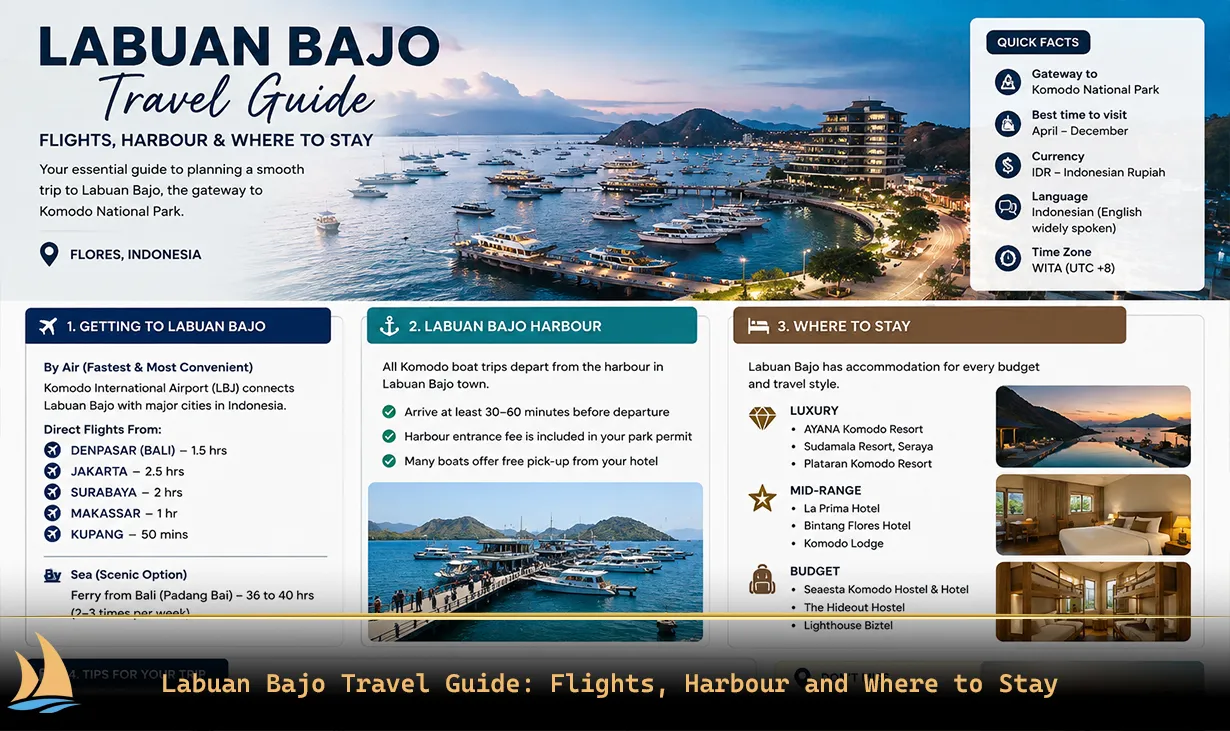

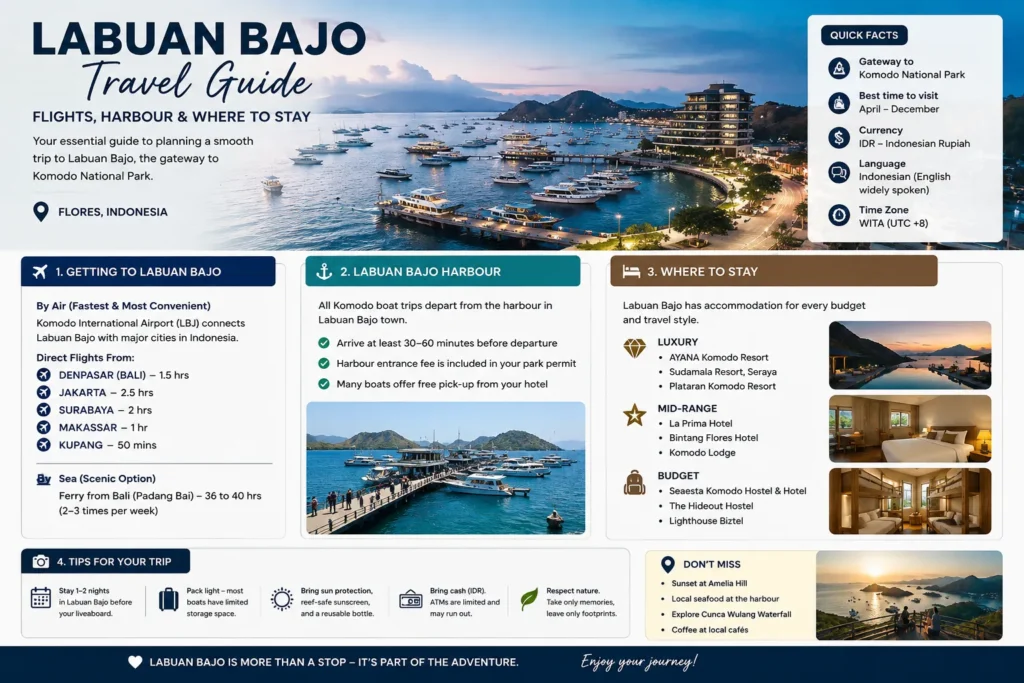
The short answer: Labuan Bajo is a small harbour town on the western tip of Flores and the only practical gateway to Komodo National Park. Fly in at least the day before your boat departs, stay somewhere you can reach the harbour in under twenty minutes, and carry cash. Everything else is detail — but the detail below is what stops trips going wrong.

Where Labuan Bajo Is and Why It Exists
Labuan Bajo sits at the far western end of Flores, in East Nusa Tenggara. Twenty years ago it was a fishing village. Today it is the departure point for essentially every boat entering Komodo National Park, and the town has grown around that single function.
Understanding this shapes your expectations usefully. Labuan Bajo is not a destination that happens to have boats; it is a harbour that has acquired hotels. The waterfront is working infrastructure — dive shops, agents, tenders, fuel — rather than a resort strip. The pleasure of the place is the bay itself, best seen from above at sunset, and the ease of getting onto the water.
The town is compact. Most of what you need sits along one main road running parallel to the harbour, with hotels climbing the hillside behind it.
How to Get to Labuan Bajo
Labuan Bajo is served by Komodo Airport (LBJ), a short drive from town.
| From | Typical flight time | Notes |
|---|---|---|
| Bali (DPS) | About 1.5 hours | The main route, multiple daily services |
| Jakarta (CGK) | About 3 hours direct, longer via Bali | Fewer direct options |
| Lombok (LOP) | About 1 hour | Limited frequency |
| Overland from east Flores | Full day or more | Scenic but slow |
| By sea from Lombok | Several days | A sailing route in its own right |
Schedules change frequently — verify before booking. Last checked: [24/08/2026].
Flying from Bali
This is how most international visitors arrive. Several carriers operate the route daily, with the bulk of departures concentrated in the morning — which matters, because that is what feeds the late-morning boat departures.
Two things to know. First, morning flights are the ones most affected by weather, and cancellations do happen in the wet season. Second, Labuan Bajo is one hour ahead of Bali. The flight crosses a time zone boundary, and people miss this. Set your phone to local time the moment you land.
Flying from Jakarta
Direct services exist but are less frequent. Many travellers connect through Bali, which turns a three-hour flight into most of a day once transfer time is counted. If you are coming from Jakarta and your boat departs the next morning, budget a full travel day.
Overland across Flores
Flores is a long, mountainous island and the road from the east is genuinely beautiful — volcanic lakes, rice terraces, traditional villages. It is also slow, winding and not for anyone prone to motion sickness. Treat it as a multi-day journey worth doing for its own sake, not as a way to reach Labuan Bajo.
Arriving by sea
Multi-day sailings from Lombok reach Komodo waters via Sumbawa and Moyo. This replaces the flight entirely and turns the transit into part of the holiday. It suits travellers with time who want the sailing rather than the destination.
Komodo Airport and Getting into Town
Komodo Airport is small, modern and easy to navigate. There is a single terminal, luggage comes off quickly, and the drive into town takes roughly fifteen to twenty minutes to the harbourside hotels — a little more to the hilltop properties.
Taxis and ride-hailing both operate, though availability thins after dark. Most hotels offer a pickup, and for a first arrival it is worth taking it: you arrive at a specific place with a specific person, rather than negotiating on the kerb after a long travel day.
The arrival cut-off that matters. If your boat departs late morning, arriving on the same morning is a gamble you will eventually lose. Flights from Bali are regularly delayed or cancelled, and the boat leaves on schedule with or without you. Arrive the previous afternoon. This single decision prevents more ruined trips than any other piece of advice on this page.
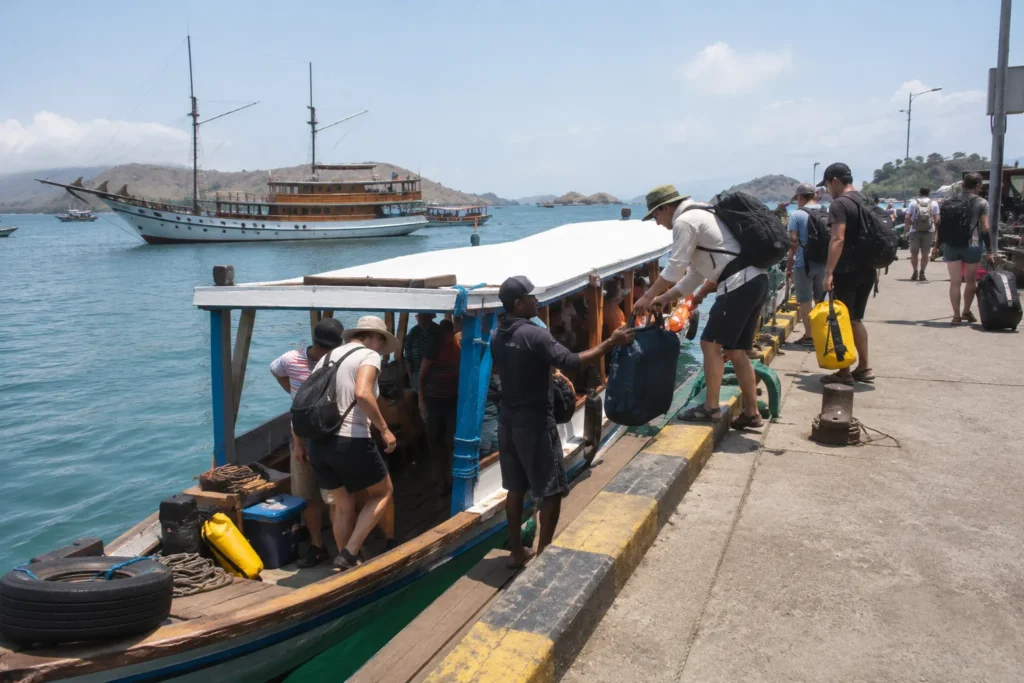
What Actually Happens on Departure Day
Guides describe the town. Almost none describe the morning you actually board, which is where most confusion happens.
The general sequence for a multi-day sailing:
- Hotel or airport pickup between 07:30 and 08:30, usually by minibus. Your operator confirms the exact time the evening before
- Harbour arrival — the pier area is busy and boats are moored in clusters, not at numbered berths you can find alone. Someone meets you; do not wander off looking for your vessel
- Tender transfer — many phinisi anchor off rather than alongside, so you board via a small boat. This is a wet step. Keep phones and documents in a dry bag
- Luggage aboard — hand luggage goes with you; large cases are usually stowed below or left ashore
- Safety briefing — life jackets, muster point, tender procedure. Pay attention to this one
- Departure
The bag you leave behind
Most hotels store luggage free while you sail, and this is far easier than taking everything aboard. Cabin space on a phinisi is limited and there is nowhere to put a large hard-shell case. Pack a soft bag for the boat and leave the rest ashore.
Arrange this at check-in, not on departure morning when the lobby is full of people doing the same thing.
What to keep with you
Passport, permit confirmation, cash, sunscreen, medication, and anything you would be unhappy to lose. Everything else can be stowed.
Where to Stay
Two decisions: budget, and hill versus harbour.
Harbourside
Puts you minutes from the pier, the restaurants, the dive shops and the agents. Convenient, walkable, and noisier — boat engines start early and the main road carries traffic until late. Best for a single night before an early departure, when convenience beats everything.
Hilltop
Gives you the view Labuan Bajo is known for: islands scattered across the bay, the whole thing turning orange at sunset. The trade-off is needing transport for every meal and every errand. Best for the night after your sailing, when you have time to enjoy where you are.
By budget
| Tier | What you get | Best for |
|---|---|---|
| Guesthouse / hostel | Simple rooms, fan or basic aircon, often family-run | Single transit nights, solo travellers |
| Mid-range hotel | Reliable aircon, hot water, breakfast, pool | Most travellers, either side of a sailing |
| Boutique hillside | Views, design, good restaurant on site | The post-trip night, honeymooners |
| Resort | Full facilities, often out of town | Longer stays, families wanting a base |
Book ahead for the dry season. The town has grown fast but peak-season demand still outruns supply, and the good mid-range properties go first. In the wet season you can often walk in.
One practical filter: ask whether the property offers early breakfast. If your pickup is at 09:00 and breakfast starts at 08:00, that is fine. If breakfast starts at 08:30, you will be eating in a hurry.
Things to Do in Labuan Bajo
Most people treat the town as a transit point. It rewards a spare afternoon.
Sunset viewpoints
The standard evening activity, and genuinely worth it. Several bars and restaurants sit on the ridge above the harbour with west-facing terraces looking out over the islands. Arrive an hour before sunset for a table; the good ones fill.
Cunca Wulang
A canyon and waterfall inland, roughly a half-day with transport and a short trek at the end. You swim in a rock pool between canyon walls. Best in or just after the wet season when the water is up; it can be thin by late dry season.
Batu Cermin cave
The “mirror cave” — a limestone system just outside town where light entering through gaps reflects off the walls at certain hours. Short, close, and a reasonable filler if you have two hours rather than half a day. Go mid-morning when the light works.
Melo village
A Manggarai village in the hills where the caci whip dance is performed. This needs arranging in advance rather than turning up, and it is more rewarding if booked through someone who can explain what you are watching.
Rangko Cave
A saltwater pool inside a coastal cave north of town, reached by road then a short boat hop. Quieter than the standard stops and photogenic when the midday light drops through the opening.
Eating and drinking
The waterfront night market is the reliable choice — grilled fish chosen from ice, priced by weight, cooked while you wait. Beyond that, the town punches above its weight: there are good Italian, Indonesian and fusion kitchens along the main road, most of them small and worth booking on a busy evening.
Flores is a serious coffee-growing island, and Labuan Bajo is where much of it surfaces. The specialty cafés here are better than the town’s size suggests.
Practicalities
- Cash. ATMs exist but run empty or offline, particularly at weekends and in peak season. Withdraw in Bali or Jakarta before you fly and carry rupiah for tips, small purchases and any on-site fees
- Cards. Hotels and established operators accept them; most small businesses, warungs and drivers do not
- Mobile signal. Reliable in town, patchy to non-existent inside the national park. Download offline maps before you sail and warn anyone at home that you will be uncontactable
- SIM cards. Available at the airport and in town. Telkomsel generally has the best regional coverage
- Pharmacy and clinic. Both in town. Bring anything specific with you rather than assuming a particular medication is stocked
- Diving and decompression. Confirm your travel insurance covers diving, and discuss chamber access with your dive operator before booking if that matters to you
- Power. 230V, plug types C and F. Boats vary in what they offer — check before relying on charging aboard
- Laundry. Cheap, same-day, widely available. Genuinely useful after a sailing
- Water. Drink bottled or filtered. Most boats and hotels provide refill stations; bring a reusable bottle
- Getting around. The town centre is walkable. Ride-hailing works but coverage is thinner than in Bali; hotels will call a car
How Many Days Do You Need?
One night before and one night after is the sensible minimum.
The night before protects your departure against flight delays. With pickup between 07:30 and 08:30, a same-morning arrival is not realistic.
The night after protects your onward flight against the boat returning late. On a standard 3D2N schedule the vessel is back in Labuan Bajo around 11:00 on the final day, with airport drop-off from about 12:00 — workable for an afternoon flight, but with no margin if weather delays the return. Booking a same-day onward international flight is the most common planning mistake we see, and it is entirely avoidable.
If you want to explore Flores itself, add two or three days and head inland toward the rice terraces and traditional villages. If you simply want the park, two nights in town bracketing your sailing is plenty.
Frequently Asked Questions
Is Labuan Bajo worth visiting on its own?
As a destination in itself it is pleasant rather than remarkable — a working harbour town with a very good view. Its value is as the gateway. Spend a night, enjoy the sunset, and save your time for the water.
Do I need cash in Labuan Bajo?
Yes. ATMs can be unreliable and most small businesses are cash-only. Bring rupiah with you rather than relying on withdrawing on arrival.
Is one night in Labuan Bajo enough before a boat trip?
One night before is the minimum and usually enough. Add a night afterwards as a buffer if you have an onward international flight.
Is Labuan Bajo safe?
Yes, with ordinary precautions. Petty theft is uncommon and the town is walkable. The main hazards are traffic on narrow roads and sun exposure.
What time do Komodo boats leave Labuan Bajo?
Most multi-day departures board late morning, after the morning flights from Bali have landed. Your operator confirms the pickup time the evening before.
Can you visit Komodo National Park without staying in Labuan Bajo?
In practice, no. Essentially all park access is by boat from Labuan Bajo, and since April 2026 entry requires a pre-booked permit tied to a route and date. Even multi-day sailings arriving from Lombok pass through the same system.
Is there anything to do in Labuan Bajo when it rains?
Batu Cermin cave, the cafés along the main road, and a spa afternoon cover most wet-season gaps. Rain here is usually a heavy afternoon burst rather than an all-day event.
Before You Sail
Once you are on the ground, the remaining decisions are timing and route — see our guides to the best time to visit Komodo National Park, the 2D1N, 3D2N and 4D3N itinerary comparison, and park permit booking under the 2026 quota. If you are weighing up which dragon trek to ask for, our comparison of Komodo Island versus Rinca covers it. Browse Komodo tour packages departing Labuan Bajo and wider Indonesia liveaboard itineraries, or speak to our team.