

Raja Ampat Liveaboard — Best Phinisi Dive Cruise Packages 2026
Plan your Raja Ampat liveaboard with Phinisi Trip — private phinisi charters and dive cruises across Dampier Strait, Misool, and Wayag.
A Raja Ampat liveaboard is the only practical way to dive the richest reefs on the planet. The Four Kings — Waigeo, Batanta, Salawati, and Misool, plus 1,500 smaller islands — sit at the apex of the Coral Triangle in the Bird’s Head Seascape, where scientists have recorded more than 1,700 fish species and around 75% of the world’s known hard corals. At Cape Kri in the Dampier Strait, Dr. Gerald Allen logged 374 fish species on a single dive — still the world record. The best sites are scattered across a marine park bigger than Switzerland, with no roads and almost no resorts: you either sleep on a boat here, or you miss most of it.
Phinisi Trip Indonesia runs traditional phinisi liveaboards out of Sorong from October to April, then repositions the fleet west for Komodo season — the two destinations are seasonal mirrors, which is why our Indonesia liveaboard calendar never really closes. Because we operate the boats ourselves, you book at direct rates, and your itinerary is planned by crews who read these tides every week — not resold through a marketplace.
Raja Ampat Dive Sites: 14 Reefs Worth Crossing the World For
Raja Ampat splits into four cruising areas. Here are the sites our guests ask for by name, area by area, from the classic central strait to the remote north and south.
Dampier Strait (Central)
The record-holder: 374 species in one dive. Sweepers, trevallies, and barracuda stack over a sloping reef; wobbegongs nap under the table corals.
A mid-strait seamount where fish tornado over the pinnacle and oceanic mantas cruise through in season.
So dense with fish it can darken the water column; best ridden on a running current.
A reef Allied pilots bombed in WWII after mistaking it for a Japanese ship; the craters are now swim-throughs coated in soft coral.
Raja Ampat’s most famous cleaning station, with a ranger-managed viewing line so the reef mantas keep coming.
The postcard village jetty, wrapped in schooling fusiliers and giant clams; superb for snorkelers and night dives.
An easy, colour-saturated wall minutes from the Kri anchorages, perfect as a check dive or a snorkel.
Misool (South)
One of the very few places on earth where oceanic and reef mantas share the same cleaning station.
Twin holes punched through a ridge at snorkel depth, framing divers against blue water; the surrounding walls drip with soft coral.
A nudibranch-shaped islet whose slopes hold the densest soft-coral cover and macro life in the south. Misool sits inside a strictly protected marine reserve, and the reefs show it.
Wayag & Kawe (North)
Kawe’s manta cleaning stations in gin-clear water, with the equator line a photo-stop away. The Wayag lagoon above it is the wildest anchorage in the archipelago, and its ridge-top viewpoint is the trek every long-itinerary guest remembers. The north is for expedition-length trips — see the cruising times below for why.
Fam Islands & Penemu
An acre of flawless hard coral so pristine dive guides use it to show what reefs looked like a century ago.
Penemu’s fish-swarmed pinnacles with reef sharks patrolling the drop-offs.
A river-like saltwater channel squeezed between Gam and Waigeo: mangrove roots, archerfish, soft corals in two metres of water, and light beams that belong in a cathedral. Between dives, the Piaynemo viewpoint trek delivers the lagoon panorama on every Raja Ampat postcard.
Where the Boats Sleep: Our Overnight Anchorages
Nobody plans this part but us — and it shapes your whole trip. In the Dampier Strait we anchor overnight in the Yenbuba Channel between Kri and Mansuar, five minutes’ tender ride from Cape Kri at first light, when the reef is at its busiest.
On Fam itineraries the boat sleeps inside a Penemu lagoon, ringed by karst and flat calm even when the strait is running. West Waigeo trips overnight in Aljui Bay, home to a working pearl farm and one of Raja Ampat’s best night dives right under the jetty lights. In the south we hold at Fiabacet–Yillet, putting Magic Mountain and Boo within a ten-minute tender run, and on northern expeditions we anchor inside the Wayag lagoon itself. A phinisi’s shallow draft is what makes several of these spots possible at all — steel boats wait outside.
Reading the Currents: How We Sequence the Dampier Strait
Raja Ampat’s fish density is a current phenomenon, so we don’t dive sites in geographic order — we dive them in tide order. Our cruise directors plan each day off the tide tables: Blue Magic and Sardine Reef fire on a building current, when the schools stack into the flow, so we drop there just after slack as the water starts to move. Cape Kri gets the first dive of the morning, on the tail of the night’s incoming tide. Manta Sandy works best on a gentle current — enough flow to keep the mantas queuing at the cleaning station, not so much that visibility drops.
On the strong-flow pinnacles we brief reef hooks: hook into bare rubble only, never coral, gloves stay off everywhere in the park. It’s why two boats can dive the same site on the same day and come back with completely different stories.
Raja Ampat Liveaboard Itinerary, Day by Day
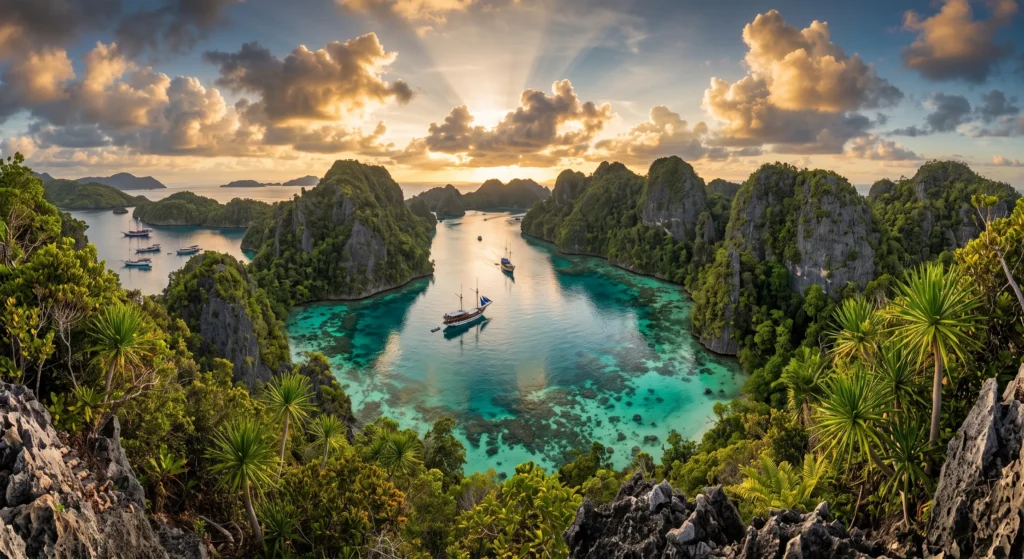
Seven nights cannot cover both ends of Raja Ampat. The archipelago runs roughly 250 km top to bottom, so every operator has to choose: north to Wayag and Kawe, or south to Misool. Anyone selling you the whole of Raja Ampat in a week is selling you crossings, not diving. Below is the northern route we run most often, followed by the southern alternative.
Northern route — 7 nights, round trip from Sorong
| Day | Area | Diving and topside |
|---|---|---|
| 1 | Sorong | Board mid-afternoon, safety and equipment briefing, check dive close to port, overnight crossing to the Dampier Strait |
| 2 | Dampier Strait | Cape Kri, Sardine Reef and Mioskon. Four dives including a night dive at Arborek jetty |
| 3 | Dampier Strait | Blue Magic and Manta Sandy on the morning tide, Arborek village visit, flying foxes over Mioskon at dusk |
| 4 | Fam and Penemu | Melissa’s Garden, Keruo and Penemu Ridge, then the climb to the Piaynemo viewpoint in the afternoon |
| 5 | Kawe | Black Rock and Eagle Rock, walls with schooling fish and reef sharks, night dive on the slope |
| 6 | Wayag | Two dives, then the Mount Pindito climb for the karst lagoon view, blacktip pups in the shallows |
| 7 | Aljui Bay | Muck diving at the pearl farm jetty, last dives, overnight crossing back toward Sorong |
| 8 | Sorong | Disembark after breakfast, transfer to SOQ airport |
Southern route — 7 nights, Misool focus
| Day | Area | Diving and topside |
|---|---|---|
| 1 | Sorong | Board, briefings, check dive, overnight crossing south |
| 2 | Dampier Strait | Cape Kri and Blue Magic on the way through, night dive |
| 3 | Misool east | Boo Windows, Tank Rock and Nudi Rock, soft coral at its densest anywhere in the archipelago |
| 4 | Misool south | Magic Mountain for mantas, Four Kings, sunset dive on the pinnacles |
| 5 | Misool west | Farondi caves, Wayilbatin and Yilliet, afternoon at the Karawapop lagoon |
| 6 | Misool north | Fiabacet and Whale Rock, kayaking through the karst in the afternoon |
| 7 | Northbound | Two dives on the return leg, then the crossing to Sorong |
| 8 | Sorong | Disembark after breakfast |
Ten and eleven-night itineraries link both ends and add Aljui Bay or the Batanta muck sites. If you want Wayag’s karst and Misool’s soft coral on the same trip, that is the length it takes.
Best Time for a Raja Ampat Liveaboard
The liveaboard season runs October to April, when the seas are calmest across the whole park. Within it, the months feel different:
| Months | Conditions | What it means for your trip |
|---|---|---|
|
October – November |
Season opening, light winds |
Fewer boats on the sites, full route flexibility north and south |
|
December – March |
Peak season, occasional NW showers |
Manta aggregations at Manta Sandy, Eagle Rock & Magic Mountain; book 6–12 months ahead |
|
April – May |
Calm shoulder, plankton blooms easing |
Excellent visibility, quieter park, best value on cabins |
|
June – September |
SE trade winds, choppy south |
Fleet repositions to Komodo — its prime season |
Water sits at 27–30°C year-round; a 3mm suit or a skin is plenty. Visibility runs 15–30m and dips when plankton arrives — which is exactly when the mantas do.
Raja Ampat Liveaboard Prices
Raja Ampat costs more than Komodo for one honest reason: distance. Everything — fuel, provisioning, crew rotations — travels through Sorong. As the operator we publish USD rates with no marketplace margin; for context, the same class of cabin retails 15–25% higher through booking portals.
| Itinerary | Route focus | From (USD pp, shared cabin) |
|---|---|---|
|
4D3N |
Dampier Strait essentials |
$750 |
|
5D4N |
Dampier Strait + Fam/Penemu |
$900 |
|
7D6N |
Central + Misool or Central + North |
$1,500 |
|
10D9N+ |
Full north–south expedition |
$2,400 |
Raja Ampat Liveaboard Permits & Park Fees
Since the 2025 restructure there are two separate official fees, issued by two different offices — most booking sites still describe the old single fee, so here is the current system:
| Fee | Amount | Validity | Where it's issued |
|---|---|---|---|
|
Marine Park Entry Permit (TLPJL / environmental services card) |
IDR 700,000 international · IDR 425,000 Indonesian |
12 months from issue |
Online via the park authority (kkprajaampat.com) or the BLUD UPTD office in Waisai |
|
Visitor Entry Ticket (regency tourism levy) |
IDR 300,000 |
Single visit |
Online via Sipari or at Waisai port |
Children under 12 are exempt from the marine park permit. Patrol boats run spot checks at sea, so the card (or digital receipt) travels with you on every dive day. We handle both permits for our guests before embarkation — you’ll never queue in Waisai — but the fees themselves are government charges paid at cost, on top of the trip price.
Getting to Sorong & Cruising Times Between Areas
Every Raja Ampat liveaboard starts in Sorong (SOQ), Southwest Papua. Direct flights run from Jakarta (about 4 hours) and via Makassar or Manado from Bali and most Indonesian hubs. Red-eye departures land in Sorong early morning; we meet you at arrivals and board by midday, with the first check dive that afternoon. No Waisai ferry needed — the boat is the transfer.
What the aggregator sites never show you is the geography that decides your route. Typical phinisi cruising times at 7–8 knots (weather dependent):
| Leg | Approx. steaming time |
|---|---|
|
Sorong → Dampier Strait (Kri/Mansuar) |
3 – 5 hours |
|
Dampier Strait → Fam / Penemu |
2 – 3 hours |
|
Fam → Wayag & Kawe (north) |
5 – 7 hours |
|
Sorong → Misool (south) |
10 – 12 hours, sailed overnight |
|
Misool → Dampier Strait |
8 – 10 hours |
That table is the whole route-planning framework: a 4D3N or 5D4N stays in the Dampier–Fam core, where the density of world-class sites is highest per mile; a 7D6N can add either Misool or the north using one overnight steam; only 10 days or more does both ends of the park justice without turning the trip into a delivery run.
Marine Life & Conservation
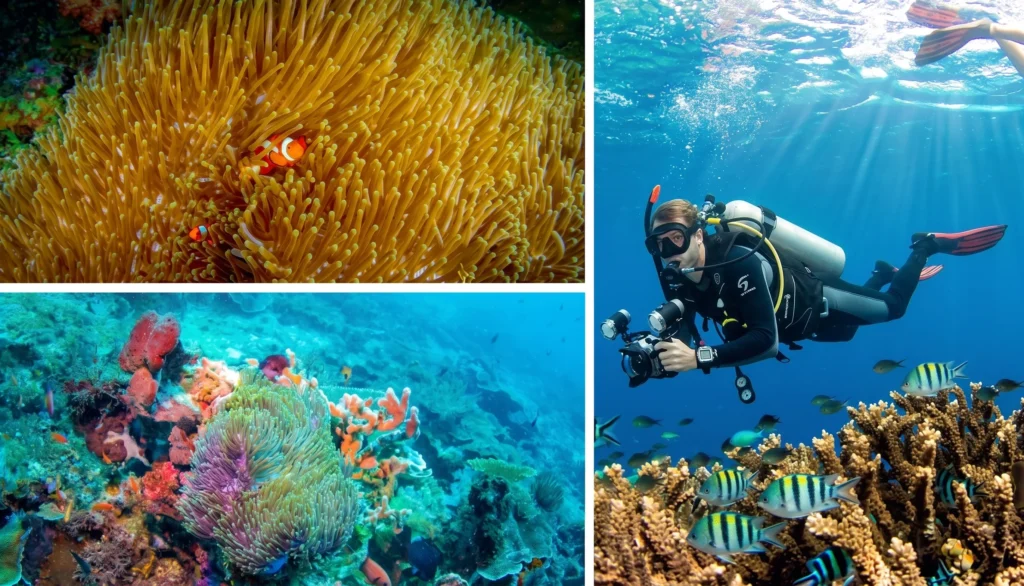
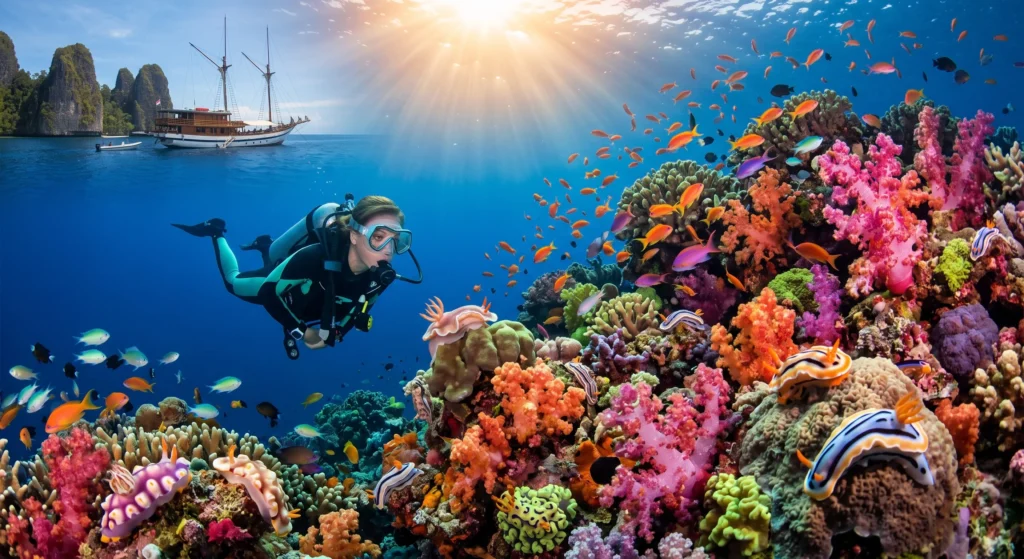
Raja Ampat diving is famous for the endemics as much as the numbers: tasselled wobbegongs under the plate corals, walking (epaulette) sharks on night dives, both manta species at the cleaning stations, and macro from Denise’s pygmy seahorses to wintering nudibranch congregations. The health of it all is no accident.
Raja Ampat declared Indonesia’s first shark and manta ray sanctuary in 2013, and inside the Misool Marine Reserve’s no-take zones independent surveys have recorded fish biomass rebounding by roughly 250% within six years — among the fastest documented reef recoveries anywhere.
Your park fees and village anchorage payments fund the patrols that keep it that way, and our briefings hold every guest to the park’s no-touch, no-glove, reef-hook-on-rubble code.
Who Should Book, Divers, Snorkelers, Photographers
Most operators, us included, recommend an Advanced Open Water certificate and around 30–50 logged dives for the full site list, since the strait’s signature dives are current dives. Newer divers are genuinely welcome on Dampier and Fam routes: we group by experience, keep guide ratios small, and there are enough sheltered reefs (Friwen, Melissa’s Garden, the jetties) to fill a trip.
Non-divers are not passengers here. A Raja Ampat snorkeling liveaboard reaches the same headline reefs the divers get, because the best of them begin two metres from the surface — Arborek Jetty, Yenbuba, Friwen Wall and The Passage are all snorkel depth. Our overnight anchorage in the Yenbuba Channel means you can be in the water off the swim platform before breakfast, no tender needed, and on the moving sites we drift-snorkel with the tender trailing you rather than swimming from a boat at anchor. The current that makes these reefs difficult is the same current that puts the fish there.
Photographers should bring both rigs: this is a wide-angle destination with world-class macro hiding in it.
What's Included (and the Fees Nobody Mentions)
Every trip includes: all meals on board (Indonesian and Western, cooked fresh by the boat’s own crew), drinking water, tea and coffee, tanks and weights for divers, snorkeling gear, tender transfers to every stop, airport or harbour pickup at your departure port, and licensed local dive guides.
Not included — budget for these:
- National park & marine fees, which vary by region — the Komodo park entrance, Raja Ampat's two permits (marine park card + visitor ticket), and small local port and village fees on Banda, Alor and Halmahera crossings. All paid separately, at cost; exact figures are on each destination page.
- Dive equipment rental and nitrox if you're diving. A few regions (Alor and the Banda Sea) run cold upwellings, so a 5mm wetsuit with a hood is recommended there.
- Alcoholic drinks, travel insurance with dive and evacuation cover (essential on remote routes), and flights to your departure port.
Discover Raja Ampat's Best Diving on a Premium Phinisi Liveaboard
Harnessing Decades at Sea to Craft Effortless Raja Ampat Liveaboard Adventures
- Save time with a fully organized itinerary
- Travel safely with licensed local dive guides
- Dive the right region for any month — we sail year-round
- Minimize stress with an all-inclusive package
- Create memories that last a lifetime
- Skip the guesswork of remote Raja Ampat logistics
- Support local crews and coastal communities in Raja Ampat
Choose your liveaboard adventure length
Delivering Premium Phinisi Voyages for a Safer, More Memorable Journey
Empowering travelers with premium phinisi voyages that combine comfort, safety, and adventure — delivering unforgettable dive trips across Indonesia while supporting local crews and coastal communities.
Choose Your Raja Ampat Liveaboard Tier
Phinisi Trip Indonesia runs every route — from Komodo to Raja Ampat and the far eastern seas — across three vessel tiers, so you match the boat to your travel style, not the other way around.
VVIP Phinisi
The most exclusive tier: the largest cabins, the highest crew-to-guest ratio, and premium finishes for a fully private, top-of-the-line liveaboard anywhere in Raja Ampat.
Luxury Phinisi
Spacious cabins, refined interiors, and attentive service for a private Raja Ampat liveaboard without the VVIP price tag.
Going deeper than this page: the dive-site chips above are the overview. The full picture — SIPARI registration, how the sites split across a real week, and which cruising area suits your experience — lives in our Raja Ampat diving liveaboard guide. Travelling with non-divers? The same lagoons, jetties and manta stations work without tanks; see the Raja Ampat snorkeling liveaboard guide. Most open trips run divers and snorkellers side by side.
Frequently Asked Questions
How much diving experience do I need for Raja Ampat?
Advanced Open Water and roughly 30–50 logged dives is the comfortable benchmark for the full site list, because the best dives run on current. Confident newer divers can absolutely join Dampier–Fam routes — we group divers by experience and keep the strongest-flow pinnacles optional.
How much does a Raja Ampat liveaboard cost?
Direct shared-cabin rates start around $750 for a 4D3N and $900 for a 5D4N, rising to $1,500+ for 7D6N routes and $2,400+ for full north–south expeditions. Government park fees (about IDR 1,000,000 total for international visitors on a first entry) are separate, and private charters start from roughly $2,000 per day.
When is the best time to go?
October to April. December to March is peak manta season at the cleaning stations; October–November and April–May trade a little wildlife predictability for empty sites and better cabin rates. From June to September the fleet sails Komodo instead.
What permits do I need in 2026?
Two: the Marine Park Entry Permit (IDR 700,000 for internationals, valid 12 months, children under 12 exempt) and the per-visit Visitor Entry Ticket (IDR 300,000). We arrange both before you board.
Will I have phone signal or internet on board?
Plan to be offline. Coverage fades within a few hours of Sorong and is patchy at best around Waisai and the Dampier villages; the north and Misool have essentially none. Tell people you’ll resurface in a week — it’s half the point.
Can non-divers or snorkelers join?
Yes — Raja Ampat is arguably Indonesia’s best snorkeling destination. Arborek Jetty, Friwen, and the Yenbuba channel are world-class from the surface, and the Piaynemo and Wayag viewpoint treks, village visits, and lagoon kayaking fill the surface intervals.
Should I pick the 5D4N or a longer route?
Five days covers the Dampier Strait and Fam — the densest concentration of elite sites in the park. Choose 7D6N to add Misool or the north (one overnight steam each), and 10+ days if you want both. The cruising-times table above is the honest logic behind every route we sell.